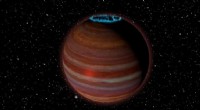
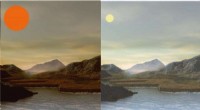
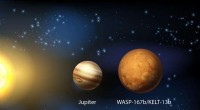
* No solid surface: Jupiter is a gas giant. It doesn't have a solid surface like Earth, so there's no specific point where the sun "rises" over a horizon.
* Internal heat: Jupiter actually generates its own heat, which is why it appears brighter than the sun's reflected light.
While you can't see a "sunrise" on Jupiter, it does experience a Jovian day, which is the time it takes for the planet to complete one rotation. This is about 10 hours.
Therefore, there are approximately 8,760 Jovian days in a year (365 days x 24 hours/day / 10 hours/Jovian day).
However, it's important to remember that this is just a measure of rotation, not a sunrise event.