Mathematical Models:
* Predicting Phenomena: Scientists use mathematical models to predict how different physical phenomena should behave based on their theories. For example, models of the Big Bang can predict the distribution of cosmic microwave background radiation.
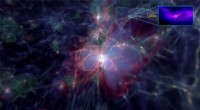
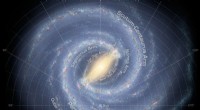
* Simulating Complex Systems: Many aspects of the universe are incredibly complex, and it's impossible to replicate them in a lab. Mathematical models allow scientists to simulate these systems, such as the formation of galaxies, the evolution of stars, or the interaction of black holes.
* Testing Hypotheses: Scientists compare the predictions of their models with observational data to see if their theories are supported. If the model accurately predicts observations, it strengthens the theory. If not, it may need revision.
Satellites:
* Observing the Universe: Satellites provide us with a unique perspective on the universe, allowing us to observe things that are impossible to see from Earth.
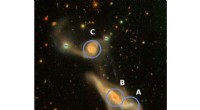
* Space Telescopes: Like Hubble and James Webb, these instruments observe distant galaxies, stars, and other celestial objects in different wavelengths of light.
* Spacecraft: Missions like Voyager and New Horizons have traveled to distant planets and asteroids, gathering data that helps us understand our solar system.
* Satellites in Earth orbit: These help us study our planet's climate, atmosphere, and geology.
Example:
One example of how scientists use both mathematical models and satellites to test theories is the study of dark matter.
* Theory: Scientists hypothesize that dark matter, an invisible substance, makes up a significant portion of the universe's mass.
* Mathematical models: They develop models to predict how dark matter should affect the rotation of galaxies and the gravitational lensing of light.
* Satellites: Observational data from satellites like the Hubble Space Telescope and the Planck satellite confirm the predicted effects of dark matter, providing evidence for its existence.
In Conclusion: Mathematical models and satellites are crucial tools for scientists studying the universe. They provide the means to test theories, predict phenomena, and gather observational data that helps us understand the vastness and complexity of the cosmos.