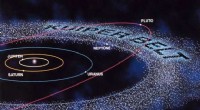
Here's why planets stay in orbit and don't go everywhere:
* Gravity: The Sun's immense gravity pulls on the planets, keeping them in its gravitational field. This force is constantly pulling the planets towards the Sun.
* Inertia: Planets are moving, and due to inertia, they want to continue moving in a straight line. This force is acting against the Sun's gravity.
* Balance: The combination of gravity and inertia creates a balance that results in the planets following a curved path around the Sun. This curved path is called an orbit.
Imagine a ball tied to a string being swung around:
* Gravity: The string represents the Sun's gravity, constantly pulling the ball towards the center.
* Inertia: The ball's motion wants to keep it going in a straight line.
* Balance: The string keeps the ball from flying off in a straight line, resulting in circular motion.
Why don't planets fly off into space?
Planets don't fly off into space because their initial velocity is just right to balance the Sun's gravitational pull. If a planet were moving too slowly, it would be pulled into the Sun by gravity. If it were moving too fast, it would escape the Sun's gravitational pull and fly off into space.
In summary: Planets orbit the Sun because of the balance between gravity and inertia. The Sun's gravity pulls them towards it, while their inertia wants to keep them moving in a straight line. This creates the curved path we call an orbit.