Here's a breakdown of the theory:
* The universe began as an incredibly hot and dense point: This point, sometimes called a singularity, contained all the matter and energy that exists today.
* Expansion: About 13.8 billion years ago, this singularity rapidly expanded, causing a massive release of energy. This expansion continues today, and the universe is still getting bigger.
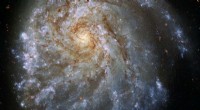
* Cooling and formation: As the universe expanded and cooled, fundamental forces separated and particles formed. Eventually, atoms formed and then stars, galaxies, and planets.
Evidence supporting the Big Bang:
* Red shift: Distant galaxies are moving away from us, and the further away they are, the faster they move. This is consistent with an expanding universe.
* Cosmic Microwave Background Radiation: This faint afterglow of the Big Bang can be detected throughout the universe.
* Abundance of elements: The relative abundance of elements in the universe is consistent with the Big Bang model of nuclear fusion in the early universe.
Important Note: The Big Bang theory doesn't explain what existed *before* the singularity, or what caused it. It's a theory about the origin of the universe as we know it, not the origin of everything.
While the Big Bang is the prevailing theory, it's important to remember that science is always evolving. New discoveries could lead to modifications or even entirely new theories in the future.