Here's a breakdown of the surface description:
Appearance:
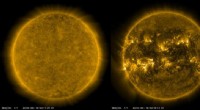
* Color: The photosphere appears yellowish-white to our eyes, but it actually emits all colors of light.
* Texture: The surface is not smooth but exhibits a grainy appearance due to granulation. These are convection cells, like giant bubbles, where hot gas rises from the Sun's interior and cools as it reaches the surface, then sinks back down.
* Sunspots: Darker areas on the photosphere are called sunspots. They are cooler regions caused by intense magnetic activity.
Composition:
* Primarily hydrogen and helium: The photosphere is about 71% hydrogen and 27% helium by mass.
* Trace elements: It also contains trace amounts of other elements like carbon, oxygen, and nitrogen.
Temperature:
* Average temperature: The photosphere has an average temperature of about 5,500 degrees Celsius (9,932 degrees Fahrenheit).
* Temperature variations: The temperature can fluctuate slightly depending on location, with sunspots being cooler than the surrounding regions.
Light Emission:
* Photons: The photosphere emits photons of light across the entire electromagnetic spectrum, from radio waves to gamma rays.
* Visible light: We see the visible light emitted by the photosphere as sunlight.
Other Features:
* Solar flares: These are sudden, intense bursts of energy that can erupt from the photosphere.
* Coronal mass ejections (CMEs): These are large explosions of plasma and magnetic field that can be released from the photosphere.
It's important to remember that the Sun's surface is constantly in motion and changing due to its dynamic and energetic nature.