Here's why:
* Blackbody Radiation: Stars emit light like a blackbody radiator, meaning they radiate energy across a range of wavelengths. The peak wavelength of this radiation is directly related to the star's temperature.
* Wien's Law: This law states that the wavelength of peak emission from a blackbody is inversely proportional to its temperature. So, hotter stars emit more of their light at shorter wavelengths (blue and violet), while cooler stars emit more of their light at longer wavelengths (red and orange).
The Color Spectrum:
* Blue/White Stars: Very hot stars (around 25,000 K and above)
* White Stars: Hot stars (around 7,500-10,000 K)
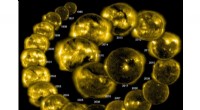
* Yellow Stars: Our Sun, a medium-hot star (around 5,500 K)
* Orange Stars: Cooler stars (around 3,500-4,500 K)
* Red Stars: The coolest stars (around 3,000 K and below)
Other Factors:
While temperature is the primary factor, other factors can subtly influence a star's color:
* Composition: The elements present in a star's atmosphere can slightly affect its color.
* Distance: As light travels through space, it can be affected by dust and gas, slightly altering its color.
* Interstellar Reddening: Dust and gas in space can absorb blue light more effectively, making distant stars appear redder than they actually are.
However, these factors generally have a less significant impact compared to the star's temperature.