Observational Tools:
* Telescopes:
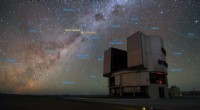
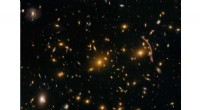
* Optical Telescopes: Capture visible light, providing images and spectra of celestial objects. Examples include the Hubble Space Telescope and the Very Large Telescope.
* Radio Telescopes: Detect radio waves emitted by objects like pulsars, galaxies, and gas clouds. The Very Large Array and the Arecibo Observatory are prominent examples.
* Infrared Telescopes: Observe infrared radiation, which allows for studying cooler objects and penetrating dust clouds. The Spitzer Space Telescope and the James Webb Space Telescope are key examples.
* Ultraviolet, X-ray, and Gamma-ray Telescopes: Detect these high-energy radiation types, revealing phenomena like black holes, supernovae, and active galactic nuclei. Examples include the Chandra X-ray Observatory and the Fermi Gamma-ray Space Telescope.
* Spectrometers: Analyze the light from celestial objects, breaking it down into its constituent wavelengths to determine composition, temperature, and motion.
* Interferometers: Combine signals from multiple telescopes to achieve higher resolution and sensitivity.
* Spacecraft: Some telescopes are launched into space to escape Earth's atmosphere and observe across the full electromagnetic spectrum. Missions like Voyager, Cassini, and Juno provide close-up observations of planets and their moons.
* Particle Detectors: Used to study cosmic rays, high-energy particles from space that can provide information about distant sources and galactic evolution.
Theoretical Tools:
* Computer Simulations: Used to model complex astrophysical phenomena, such as galaxy formation, star evolution, and black hole mergers.
* Mathematical Models: Describe fundamental physical processes in the universe, like gravity, electromagnetism, and nuclear reactions.
* Statistical Analysis: Used to analyze large datasets from observations and simulations, drawing conclusions and identifying patterns.
* Supercomputers: Provide the processing power necessary for complex simulations and data analysis.
Other Tools:
* Data Analysis Software: Programs like Python, MATLAB, and IDL are used to process and analyze astronomical data.
* Collaboration Tools: Online platforms and communication technologies enable astrophysicists worldwide to share data, collaborate on projects, and disseminate findings.
The Future of Astrophysics:
Advancements in technology are continually expanding the toolkit of astrophysicists. Future endeavors include:
* Next-Generation Telescopes: Larger and more powerful telescopes like the Extremely Large Telescope and the Thirty Meter Telescope will provide unprecedented views of the universe.
* Gravitational Wave Observatories: Detectors like LIGO and Virgo are opening up new windows into the universe by observing gravitational waves, revealing the merger of black holes and neutron stars.
* Artificial Intelligence and Machine Learning: AI will be increasingly used to analyze vast datasets, identify patterns, and make predictions.
Astrophysics is a dynamic field, and the tools used by astrophysicists are constantly evolving. These tools enable them to explore the universe and unravel its mysteries, pushing the boundaries of human knowledge.