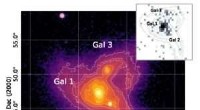
Visible Light: This is the portion of the electromagnetic spectrum that our eyes can see, giving us the familiar images of stars and galaxies.
Infrared Radiation: Stars emit a significant amount of infrared radiation, especially cooler stars. This radiation helps us study the dust and gas clouds in galaxies, as well as the formation of stars and planets.
Ultraviolet Radiation: Hotter stars emit a large amount of ultraviolet radiation. This radiation can ionize gas in space, creating nebulae, and is used to study the composition and temperature of stars.
X-rays: Active galactic nuclei (AGN) and supernova remnants emit powerful X-rays. These high-energy photons help us study the very hot and dense regions in galaxies, such as black holes and neutron stars.
Gamma Rays: The most energetic form of electromagnetic radiation, gamma rays are produced by powerful events like supernovae and the collision of galaxies. They provide insights into the most violent processes in the universe.
Radio Waves: Galaxies emit radio waves from various sources, including supernova remnants, pulsars, and active galactic nuclei. These waves are used to study the structure and evolution of galaxies and the interstellar medium.
Microwaves: The cosmic microwave background (CMB) radiation, a remnant of the Big Bang, falls in the microwave region of the spectrum. This radiation provides valuable information about the early universe.
In summary, stars and galaxies emit a diverse range of electromagnetic radiation, from the low-energy radio waves to the high-energy gamma rays. Studying these different wavelengths allows astronomers to gain a comprehensive understanding of the universe and its constituents.