1. No Friction or Resistance:
* Motion: Celestial bodies can move freely without encountering significant friction or resistance. This allows them to maintain their orbits for billions of years. Imagine a ball thrown in space – it would just keep moving forever!
* No Sound: Sound waves need a medium to travel, and since there's almost no matter in space, there's no sound.
2. Heat Transfer is Limited:
* Radiation: Heat can only be transferred through radiation. This means celestial bodies primarily gain heat from their stars and lose heat into the cold of space.
* Slow Cooling: Planets and other objects cool very slowly because they are essentially isolated in a near-perfect vacuum.
3. Extreme Temperatures:
* Solar Radiation: Celestial bodies directly exposed to the sun experience extreme temperatures, while those in the shade can reach frigid lows.
* Absence of Atmosphere: Lack of an atmosphere means no insulation, leading to large temperature swings.
4. Conservation of Momentum:
* Gravity: The vacuum allows gravity to act as the dominant force. This leads to the formation of galaxies, stars, and planets.
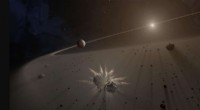
* Collisions: Collisions between celestial bodies have dramatic consequences in the vacuum of space, as there's no air resistance to slow them down.
5. Impact Craters:
* No Atmosphere: The lack of atmosphere means celestial objects hit surfaces directly, creating impact craters.
* Meteoroids: Small objects called meteoroids can travel through space at incredible speeds, leaving behind trails of debris when they hit planets or moons.
Not a Perfect Vacuum:
While space is incredibly close to a vacuum, it's not entirely empty. There are:
* Interstellar gas and dust: These are extremely thin but exist in space, especially in regions of star formation.
* Cosmic rays: These are high-energy particles that can travel through space, interacting with other celestial bodies.
* Magnetic fields: These are generated by celestial objects, including stars and planets.
In conclusion, the near-perfect vacuum of space has profound effects on the behavior of celestial bodies. It allows for frictionless motion, extreme temperatures, and the dominance of gravity. The vacuum is what shapes the universe as we know it.