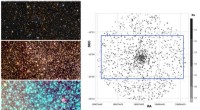
* The types of stars they contain: Younger, hotter stars tend to be blue, while older, cooler stars are redder.
* The amount of dust and gas: Dust absorbs light, making galaxies appear redder.
* The distance from Earth: Light from distant galaxies is stretched by the expanding universe, making them appear redder (redshift).
Here's a general breakdown:
* Spiral galaxies: Often appear bluish due to their abundance of young, hot stars in their spiral arms.
* Elliptical galaxies: Tend to be yellowish or reddish, as they contain mostly older, cooler stars.
* Irregular galaxies: Can have a mix of colors depending on their star populations and dust content.
It's important to note that:
* The colors we see in images of galaxies are often enhanced or manipulated for scientific or aesthetic purposes.
* Human eyes cannot see the full spectrum of light emitted by galaxies, so these images are not what we would see with our naked eyes.
So, while there's no single "galaxy color," there's a fascinating variety of hues reflecting the diverse and complex nature of these celestial objects.