* Visible light: This is the portion of the electromagnetic spectrum that our eyes can see, giving stars their characteristic colors.
* Infrared radiation: This is heat radiation, and stars emit a significant amount of it.
* Ultraviolet radiation: This is a higher energy form of radiation than visible light, and it can be harmful to living organisms.
* X-rays: These are even higher energy radiation, and they are emitted by very hot and active stars.
* Gamma rays: These are the highest energy form of electromagnetic radiation, and they are emitted by some of the most energetic events in the universe, such as supernovae.
In addition to electromagnetic radiation, stars also emit particles, such as:
* Neutrinos: These are subatomic particles that interact very weakly with matter.
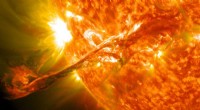
* Solar wind: This is a stream of charged particles that is constantly flowing from the Sun.
The specific type and amount of radiation emitted by a star depends on its temperature, size, and age. For example, cooler stars emit more infrared radiation, while hotter stars emit more ultraviolet and X-ray radiation.