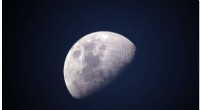
The Giant Impact Hypothesis (Most Popular)
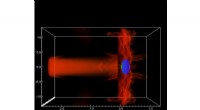
* Hypothesis: The Moon formed from a giant impact between Earth and a Mars-sized object called Theia.
* Explanation:
* Early in the Solar System's formation, a massive collision occurred.
* The impact blasted material from both Earth and Theia into orbit.
* This debris coalesced over time, forming the Moon.
* Evidence:
* Similarities in Oxygen Isotopes: Earth and the Moon share remarkably similar oxygen isotope ratios, suggesting a common origin.
* Moon's Composition: The Moon is relatively poor in volatile elements (like water) and rich in iron, which aligns with a high-energy impact scenario.
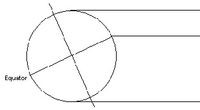
* Lunar Tilt: The Moon's orbit is tilted relative to Earth's equator, which is consistent with a large impact event.
Alternative Hypotheses:
* Co-accretion: Earth and the Moon formed independently but in close proximity, growing from the same disk of dust and gas.
* Capture Hypothesis: The Moon formed elsewhere in the Solar System and was later gravitationally captured by Earth.
Why the Giant Impact Hypothesis is Favored
* Best Explains Evidence: It best explains the observed evidence, including the isotopic similarities and the Moon's unusual composition.
* Computer Simulations: Sophisticated computer simulations support the idea that a giant impact is a plausible scenario for Moon formation.
Important Note: While the Giant Impact Hypothesis is the leading theory, ongoing research and new data could lead to modifications or even the development of new hypotheses. The study of the Earth-Moon system is a dynamic and evolving field!