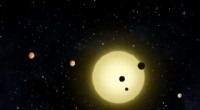
Stars appear as point sources of light through a telescope, unlike planets which show discs. This is because stars are incredibly far away, even the closest ones.
Here's what you can observe about stars through a telescope:
1. Color:
* Stars come in a variety of colors, from red to blue, depending on their temperature.
* Hotter stars appear bluer, while cooler stars appear redder.
* A telescope can reveal the subtle color variations even in stars that appear white to the naked eye.
2. Magnitude:
* Different stars have different brightness, or magnitude.
* A telescope can reveal fainter stars that are invisible to the naked eye.
* Variable stars change in brightness over time, and a telescope can track this variability.
3. Binary Stars:
* Some stars are actually two stars orbiting each other.
* A telescope can sometimes reveal the two stars as separate points of light.
* Observing binary stars helps astronomers understand stellar evolution and gravitational interactions.
4. Star Clusters:
* A telescope can reveal collections of stars called star clusters.
* Open clusters are loose collections of young stars.
* Globular clusters are dense spheres of older stars.
* Observing star clusters helps astronomers understand the formation and evolution of stars.
Best Observing Conditions:
* Dark skies: Light pollution from cities significantly reduces the visibility of stars. Find a location with minimal light pollution.
* Clear skies: Clouds obscure the stars, so choose a night with clear skies.
* Steady atmosphere: A turbulent atmosphere can cause stars to twinkle, making it difficult to see them clearly.
* Proper telescope setup: Ensure your telescope is properly aligned and focused for optimal viewing.
* Patience: It takes time to adjust to the darkness and learn how to use the telescope effectively.
Tips for Observing Stars:
* Start with brighter stars: These are easier to see through a telescope.
* Use low magnification: Higher magnification can make stars appear blurry in a turbulent atmosphere.
* Try different filters: Filters can enhance the visibility of certain colors of light, revealing more detail.
* Draw what you see: This can help you remember the details and track changes over time.
With a bit of patience and practice, you can use a telescope to explore the wonders of the night sky and observe stars in greater detail.