Size and Mass:
* The largest planet: It's a gas giant with a diameter 11 times that of Earth and a mass over 300 times greater.
* More massive than all other planets combined: Jupiter's gravity is so strong that it dominates the solar system's outer region.
Composition:
* Mostly hydrogen and helium: Jupiter is primarily made up of the lightest elements, similar to the Sun. This makes it a fascinating object for studying planetary formation.
* No solid surface: Jupiter is a gas giant, so there's no solid ground to stand on.
Atmosphere:
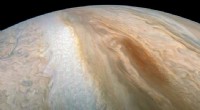
* Dynamic and turbulent: Jupiter's atmosphere is constantly swirling with powerful storms and features, including the famous Great Red Spot.
* Colorful and dramatic: Its atmosphere displays a vibrant palette of colors due to the presence of various chemicals.
Moons:
* Home to a vast moon system: Jupiter has 79 confirmed moons, more than any other planet in our solar system.
* Some moons are very intriguing: Europa, with its potential subsurface ocean, and Ganymede, the largest moon in the solar system, are prime targets for exploring potential life beyond Earth.
Magnetic Field:
* Extremely powerful magnetic field: Jupiter's magnetic field is the strongest in the solar system, 14 times stronger than Earth's. It traps particles from the Sun, creating a massive radiation belt.
Scientific Significance:
* Key to understanding planetary formation: Studying Jupiter helps scientists understand how gas giants form and the early stages of the solar system.
* Potential for life: Some of Jupiter's moons, like Europa and Ganymede, are thought to harbor conditions that could support life.
Cultural Significance:
* Named after the Roman king of the gods: Jupiter has been a source of fascination and inspiration for civilizations throughout history.
* A popular subject of art and literature: Jupiter's beauty and mystery have captured the imagination of artists and writers for centuries.
In short, Jupiter is a truly unique and extraordinary planet. Its size, composition, atmosphere, moon system, and magnetic field make it a truly special object in our solar system, offering valuable insights into the origins of our planet and the potential for life beyond Earth.