* Nuclear Fusion: Stars form when a large cloud of gas and dust collapses under its own gravity. This collapse creates immense pressure and heat at the core. If the core reaches a critical temperature and pressure, nuclear fusion begins. This is where hydrogen atoms fuse to form helium, releasing a tremendous amount of energy, making the object shine.
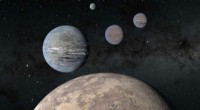
* Jupiter's Mass: Jupiter is the largest planet in our solar system, but it's still significantly smaller than the smallest stars. It has about 1/1000th the mass of the Sun, which is the minimum mass required for a star to initiate nuclear fusion.
* Failed Star: Some astronomers refer to Jupiter as a "failed star" because it has a rocky core and a thick atmosphere of hydrogen and helium, similar to the composition of stars. However, its lack of mass prevented it from reaching the conditions necessary for nuclear fusion.
In Summary: Jupiter's size, while large compared to other planets, is simply too small to ignite the nuclear fusion process that defines a star.