Here's why:
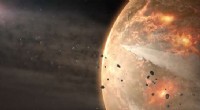
* Formation: Gas giants and terrestrial planets form differently. Terrestrial planets form closer to the star in the protoplanetary disk, where the material is denser and mostly rocky. Gas giants form farther out, where the material is less dense and mostly gas.
* Orbital Mechanics: The distance of a planet from its star is determined by its orbital path, influenced by the star's gravity and the initial conditions of the protoplanetary disk.
* Examples:
* Our Solar System: Jupiter and Saturn are gas giants, but they're much farther out than Mars, a terrestrial planet. Uranus and Neptune, also gas giants, are even farther out.
* Exoplanet Systems: We've discovered many exoplanet systems where gas giants orbit close to their stars (called "hot Jupiters").
In summary, while the types of planets form in different regions of the protoplanetary disk, their final orbital distances can vary significantly.