1. Gravity: Gravity is the primary force responsible for clustering stars into galaxies.
* Gravitational Collapse: Early in the universe, small density fluctuations in the otherwise evenly distributed matter led to regions with slightly higher density. These regions had stronger gravitational pull, attracting more matter and growing denser. This process continued until large clouds of gas collapsed under their own gravity, forming galaxies.
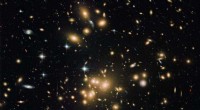
* Galaxies and Clusters: Within galaxies, stars continue to be influenced by gravity. Stars tend to cluster in groups, spiral arms, and even bulge around the galactic center. Galaxies themselves also cluster together, forming larger structures called galaxy clusters.
2. Galactic Dynamics: The internal dynamics of galaxies also play a role.
* Spiral Arms: Spiral galaxies have distinct spiral arms where young, hot stars are concentrated. This is because these arms are regions of enhanced density, where gas clouds collide and trigger star formation.
* Supernovae: Massive stars explode as supernovae, leaving behind remnants and shock waves that can trigger new star formation. These events can create pockets of star formation within a galaxy.
3. Dark Matter: While we cannot directly see dark matter, its gravitational influence is significant. It makes up the majority of the mass in the universe and plays a major role in structuring galaxies and galaxy clusters.
4. Formation History: The initial conditions and subsequent evolution of the universe have also influenced star distribution. Early galaxies, formed in the early universe, often differ in shape and structure from those formed later.
5. Star Formation: Star formation is a complex process, influenced by the presence of gas clouds, dust, and various other factors. These factors can create variations in the density and distribution of stars within a galaxy.
In summary: The non-uniform distribution of stars is a result of a complex interplay of gravity, galactic dynamics, dark matter, and the history of the universe. This complex process results in the vast and intricate structures we observe in the cosmos, from individual stars to galaxies and even the vast cosmic web.