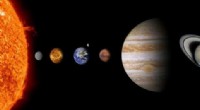
Here's why:
* Kepler's Third Law: This law states that the square of a planet's orbital period (its year) is proportional to the cube of the average distance between the planet and the sun. In simpler terms, the farther a planet is from the sun, the longer its orbit takes.
* Orbital Speed: Planets further from the sun have a slower orbital speed. This is because the sun's gravitational pull weakens with distance, so the planets experience less force pulling them towards the sun.
Example:
* Mercury, the closest planet to the sun, has a year of only 88 Earth days.
* Neptune, the furthest planet, has a year of 165 Earth years.
Therefore, the further a planet is from the sun, the longer it takes to complete a full orbit, resulting in a longer year.