Here's a breakdown of the process:
1. Solar wind: The sun constantly emits a stream of charged particles, mainly protons and electrons, known as the solar wind.
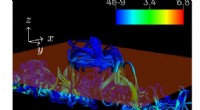
2. Magnetosphere: The Earth has a magnetic field that surrounds the planet, called the magnetosphere. This magnetic field acts like a shield, deflecting most of the solar wind.
3. Interaction: Some of the charged particles from the solar wind manage to penetrate the magnetosphere, especially near the poles where the magnetic field lines are less dense.
4. Auroral oval: These charged particles then interact with the Earth's atmosphere, mainly in a region called the auroral oval, which lies roughly 100-300 km above the poles.
5. Excitation and emission: The energetic particles collide with atoms and molecules in the atmosphere, exciting them. As these excited atoms return to their ground state, they release energy in the form of light, creating the spectacular auroral displays.
So, in short, it's the solar wind that strikes the magnetosphere and ultimately leads to the auroras.