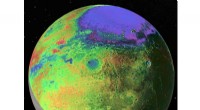
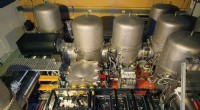
Planetary science is a multifaceted field that explores the origin, evolution, and current state of planets, moons, asteroids, comets, and other celestial bodies within our solar system and beyond. It encompasses a wide range of disciplines, including:
1. Geology: Studying the composition, structure, and processes shaping the solid surfaces of planetary bodies. This includes analyzing rock and soil samples, mapping surface features, and understanding tectonic activity, volcanoes, and impact craters.
2. Geophysics: Investigating the internal structure, composition, and dynamics of planetary interiors. This involves studying gravity fields, magnetic fields, and seismic activity.
3. Atmospheres: Analyzing the composition, structure, and dynamics of planetary atmospheres, including weather patterns, climate change, and atmospheric escape.
4. Oceans: Exploring the presence, composition, and dynamics of oceans on planetary bodies, both on the surface and beneath the ice.
5. Astrobiology: Searching for evidence of past or present life on other planets and moons. This includes studying the chemical building blocks of life, identifying habitable zones, and looking for biosignatures.
6. Formation and Evolution: Understanding how planetary systems form from collapsing clouds of gas and dust, how planets evolve over time, and the processes that lead to the diverse range of worlds we observe.
7. Comparative Planetology: Comparing and contrasting different planets and moons to understand their similarities and differences, and to learn more about the processes that shape them.
8. Exploration: Designing and conducting space missions to explore other planets and moons. This includes robotic spacecraft, landers, rovers, and future missions with human crews.
Planetary science uses a wide range of tools and techniques, including:
* Telescopes: Observing planets from Earth or space using visible light, infrared, ultraviolet, and other wavelengths.
* Spacecraft: Sending probes to collect data and samples from other planets and moons.
* Laboratory experiments: Simulating conditions on other planets to test theories and models.
* Computer simulations: Modeling planetary processes and evolution.
Why is Planetary Science Important?
* Understanding our place in the universe: It provides a broader context for understanding our own planet Earth.
* Searching for life beyond Earth: It has the potential to answer the fundamental question of whether we are alone in the universe.
* Resource exploration: It could lead to the discovery of new resources for human civilization.
* Technological innovation: It drives the development of new technologies that can be applied to other fields.
* Inspiring future generations: It fosters curiosity, creativity, and a sense of wonder about the universe.
Conclusion:
Planetary science is a dynamic and rapidly evolving field that is constantly pushing the boundaries of our knowledge about the universe. It is a field of immense scientific and societal importance, with the potential to answer some of the most fundamental questions about our existence.