1. Intrinsic Variables:
* Cepheid Variables: These stars pulsate in size, expanding and contracting, causing their brightness to change in a regular pattern. The period of their pulsations is directly related to their luminosity, making them valuable tools for measuring distances in space.
* RR Lyrae Variables: Similar to Cepheids, these stars also pulsate, but with shorter periods and lower luminosities. They are common in globular clusters.
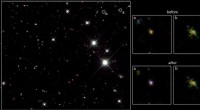
* Mira Variables: These stars experience long periods of variability, often taking months or even years to complete a cycle. Their brightness can change drastically, sometimes by a factor of hundreds or even thousands.
* Eruptive Variables: These stars experience sudden outbursts of energy, like novae and supernovae, which cause a dramatic increase in brightness.
2. Extrinsic Variables:
* Eclipsing Binary Stars: This type of variability is caused by two stars orbiting each other, where one star periodically passes in front of the other, blocking its light. The eclipses result in regular dips in brightness.
Other Factors:
* Rotation: Some stars have spots on their surface that are cooler or hotter than the surrounding area. As the star rotates, these spots become visible and obscured, causing minor fluctuations in brightness.
* Dust Clouds: If a star is located behind a cloud of dust, the dust can absorb some of its light. If the cloud moves or changes in density, the star's apparent brightness can fluctuate.
It's important to note that not all stars that appear to be variable are truly variable. Some stars may simply be affected by atmospheric conditions on Earth, which can cause their brightness to fluctuate.
To determine the true nature of a variable star, astronomers need to observe it over a long period of time and carefully analyze its light variations.