1. Granules: These are small, bright, and constantly changing features that are the tops of convection cells. Hotter gas rises in the center of each granule, radiating light and heat, then cools and sinks at the edges.
2. Sunspots: These are cooler, darker areas on the photosphere, caused by intense magnetic fields that inhibit the flow of hot plasma from the Sun's interior. Sunspots appear in pairs of opposite magnetic polarity and can be quite large, sometimes even visible to the naked eye.
3. Faculae: These are bright patches on the photosphere, caused by the concentration of magnetic fields. Faculae are hotter than the surrounding photosphere and are usually located near sunspots.
4. Plages: These are bright areas in the chromosphere, the layer above the photosphere. They are associated with sunspots and faculae and are thought to be heated by the magnetic fields.
5. Prominences: These are large, looping structures of plasma that extend from the chromosphere into the corona, the Sun's outer atmosphere. They are held in place by magnetic fields and can last for hours, days, or even weeks.
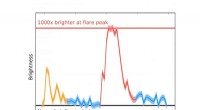
6. Flares: These are sudden, intense bursts of energy released from the Sun's atmosphere, often near sunspots. Flares emit radiation across the electromagnetic spectrum, including light, X-rays, and radio waves.
7. Coronal Mass Ejections (CMEs): These are large, explosive eruptions of plasma and magnetic field from the Sun's corona. CMEs can travel at speeds of millions of kilometers per hour and can have significant impacts on Earth, causing geomagnetic storms and aurorae.
8. The Photosphere's "Edge": While the photosphere appears as a smooth surface, it has an edge known as the limb. This is the point at which the Sun's light is no longer directly visible due to the Earth's atmosphere.
These features offer insights into the Sun's complex and ever-changing nature, providing us with a window into the processes that govern our star.