1. Gravity: The solar nebula, a vast cloud of gas and dust, began to collapse under its own gravity. As the cloud contracted, the particles within it moved closer together, increasing the density and gravitational pull at the center.
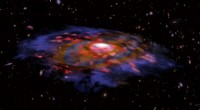
2. Conservation of Angular Momentum: As the cloud collapsed, it also began to rotate faster, similar to how a figure skater spins faster when they pull their arms in. This rotation flattened the cloud into a spinning disk, with the densest material concentrated at the center.
3. Heat and Pressure: As the material at the center continued to collapse, the particles collided with increasing frequency, generating immense heat and pressure. This process also caused the material to become increasingly ionized, forming a plasma.
4. Nuclear Fusion: Eventually, the temperature and pressure at the core of the collapsing cloud reached a point where nuclear fusion could begin. This is the process where hydrogen atoms are fused together to form helium, releasing tremendous energy. This energy output provided the outward pressure that balanced the inward pull of gravity, stabilizing the Sun and preventing further collapse.
5. Accretion: The remaining material in the disk continued to accrete onto the Sun, contributing to its mass and energy production.
In summary: The Sun formed from the center of the solar nebula due to the combined forces of gravity, conservation of angular momentum, and the initiation of nuclear fusion. This process led to the formation of a stable star that provides light and warmth to our solar system.