1. Red Supergiant:
After exhausting their hydrogen fuel, massive stars expand into red supergiants. This expansion is driven by the burning of heavier elements like helium and carbon in their core. They become enormous, with diameters hundreds of times larger than our Sun.
2. Supernova Explosion:
Eventually, the core of a massive star becomes unstable and collapses in on itself. This collapse triggers a massive explosion called a supernova. Supernovae are incredibly energetic events, releasing more energy in a few seconds than our Sun will produce in its entire lifetime.
3. Remnant:
The supernova explosion leaves behind a compact object, either a neutron star or a black hole.
Neutron Stars:
If the star's core is between 1.4 and 3 solar masses, it collapses into a neutron star. These objects are incredibly dense, packing the mass of the Sun into a sphere only about 20 km in diameter. They spin rapidly and emit powerful radio waves, creating pulsars.
Black Holes:
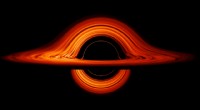
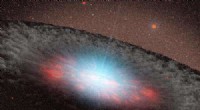
If the star's core is more massive than 3 solar masses, the collapse continues until it forms a black hole. Black holes are regions of spacetime where gravity is so strong that nothing, not even light, can escape.
In summary:
* Massive stars become red supergiants after the main sequence.
* They end their lives in spectacular supernova explosions.
* The remnants of supernovae can be neutron stars or black holes.
It's important to remember that this is a simplified explanation. The lives of massive stars are complex and there are many variations depending on the star's initial mass and composition.