Mercury:
* Weak magnetic field: Mercury has a very weak magnetic field, which is insufficient to deflect the solar wind effectively.
* Atmospheric stripping: As a result, the solar wind directly interacts with Mercury's thin exosphere, stripping away particles and contributing to its extremely tenuous atmosphere.
* Magnetosphere: Mercury's weak magnetic field creates a small magnetosphere that traps some solar wind particles, leading to a "bow shock" where the solar wind slows down and is deflected.
Venus:
* No global magnetic field: Venus lacks a global magnetic field, leaving its atmosphere directly exposed to the solar wind.
* Induced magnetosphere: Venus's rapid rotation and its electrically conductive ionosphere create an induced magnetosphere, a weak magnetic field that deflects some of the solar wind.
* Atmospheric erosion: The solar wind interacts with Venus's thick atmosphere, stripping away particles and causing a slow erosion of the atmosphere over time.
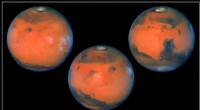
Mars:
* Weak magnetic field: Mars has a very weak magnetic field, localized to certain regions.
* Atmospheric escape: The solar wind interacts directly with Mars's thin atmosphere, leading to atmospheric escape, particularly of lighter elements like hydrogen and oxygen.
* Ionization: The solar wind ionizes the Martian atmosphere, contributing to its thinness.
* Aurora: The solar wind interacts with the Martian atmosphere, producing auroras near the magnetic poles.
In summary:
* Solar wind stripping: The solar wind directly interacts with the atmospheres of Mercury, Venus, and Mars, stripping away particles and contributing to their thin atmospheres.
* Magnetic fields: The presence or absence of a magnetic field significantly affects the interaction with the solar wind. Planets with weak or no magnetic fields, like Mercury, Venus, and Mars, are more susceptible to atmospheric erosion.
* Atmospheric composition: The solar wind can alter the composition of the atmospheres by stripping away lighter elements.
* Auroras: The solar wind can interact with the upper atmospheres of planets, producing auroras.
The study of how the solar wind interacts with the atmospheres and magnetic fields of these planets provides valuable insights into their evolution and history. Understanding these interactions is crucial for understanding the potential for life on other planets and the habitability of exoplanets.