1. Gravity:
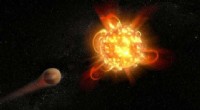
* Stars are massive objects with enormous gravitational pull. This pull acts equally in all directions, pulling all the star's matter towards its center.
* Gravity is the dominant force that wants to crush a star into a smaller and smaller volume.
2. Internal Pressure:
* Stars are giant balls of hot gas. The core of a star is incredibly hot, generating immense pressure from the nuclear fusion reactions happening there.
* This pressure pushes outward against the force of gravity.
Equilibrium:
* The spherical shape of a star is a result of the balance between these two forces.
* Gravity wants to crush the star, while internal pressure wants to expand it.
* This balance is dynamic and constantly adjusting as the star evolves.
Why a sphere?
* Gravity acts equally in all directions, pulling matter towards the center.
* This creates a uniform pressure gradient throughout the star, leading to a symmetrical shape.
* The sphere is the most stable and efficient shape for this balance of forces.
It's important to note:
* The exact shape of a star can deviate slightly from a perfect sphere due to rotation and other factors.
* Stars also experience internal turbulence and convection, which can create temporary variations in their shape.
In essence, a star's spherical shape is a consequence of the fundamental laws of physics, with gravity and pressure working together in a delicate equilibrium.