1. Galaxy Rotation Curves:
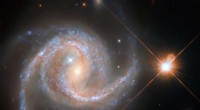
* Observed: When astronomers measure the speed of stars and gas clouds orbiting the galactic center, they find that these objects move faster than expected based on the visible matter alone. This is especially true at the outer edges of the galaxy.
* Explanation: The observed rotation speeds imply a much larger gravitational force than can be accounted for by the visible stars, gas, and dust. The presence of dark matter, which does not emit light but exerts gravitational pull, explains this discrepancy.
2. Gravitational Lensing:
* Observed: Light from distant objects is bent around massive objects in space, creating distortions or multiple images of the source. The amount of bending depends on the mass of the object.
* Explanation: Observations of gravitational lensing around galaxies and galaxy clusters reveal more mass than can be seen from the visible matter. This suggests the existence of dark matter.
3. Cosmic Microwave Background Radiation:
* Observed: The cosmic microwave background (CMB) is a faint afterglow of the Big Bang. Small fluctuations in the CMB indicate the distribution of matter in the early universe.
* Explanation: The observed pattern of CMB fluctuations can only be explained if there is a significant amount of dark matter present in the universe, influencing the distribution of matter in the early stages.
4. Structure Formation:
* Observed: Galaxies and galaxy clusters have formed and evolved in a specific way. Large-scale structures such as galaxy filaments and voids are observed in the universe.
* Explanation: Simulations of galaxy formation require the presence of dark matter to explain the observed structure and distribution of galaxies. Dark matter provides the necessary gravitational pull for structure formation and evolution.
While the exact nature of dark matter remains a mystery, these observations strongly suggest its existence and its dominant role in shaping the Milky Way and the universe as a whole.