1. The Genesis of a Nebula:
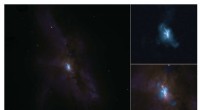
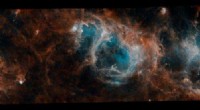
- Nebulae are immense clouds of interstellar gas (mostly hydrogen and helium) and dust.
- These clouds are often triggered into collapse by events like supernova explosions or galactic collisions.
2. Gravitational Collapse:
- Within the nebula, denser regions of gas and dust start to attract more matter due to gravity.
- As more material falls in, the core of the collapsing cloud heats up, creating a protostar.
3. The Protostar:
- The protostar continues to accrete matter from the surrounding nebula, growing in size and temperature.
- It shines with a reddish glow due to the heat generated by the gravitational collapse.
- Powerful stellar winds blast away surrounding material, creating a cavity around the protostar.
4. Nuclear Fusion Ignition:
- Eventually, the core of the protostar becomes so hot and dense that hydrogen atoms begin to fuse together, forming helium and releasing tremendous amounts of energy.
- This process, called nuclear fusion, is the birth of a true star.
5. Main Sequence Star:
- Once nuclear fusion begins, the star enters its main sequence phase.
- This is the longest and most stable phase of a star's life.
- The star's energy output and color are determined by its mass. Larger stars are hotter and bluer, while smaller stars are cooler and redder.
6. Stellar Evolution:
- As a star ages, it eventually exhausts its hydrogen fuel.
- The core contracts, and the outer layers expand, creating a red giant.
- The star's final fate depends on its mass.
Key Points:
- The birth of a star is driven by gravity, which pulls material together.
- The process of nuclear fusion is the key to a star's energy production.
- The life cycle of a star is determined by its mass.
- Stars are born in nebulae, vast clouds of gas and dust.
In short, a star is born when a cloud of gas and dust collapses under its own gravity, eventually reaching a temperature and density high enough for nuclear fusion to begin.