1. Above the Atmosphere:
* The Earth's atmosphere is a major source of distortion for ground-based telescopes. It constantly moves and creates turbulence, blurring the light from distant objects.
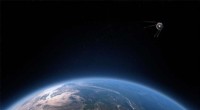
* Hubble orbits above the atmosphere, giving it a clear, stable view of the cosmos.
2. Sharper Resolution:
* Because Hubble isn't affected by atmospheric distortion, its images are much sharper and have higher resolution than ground-based telescopes. This means it can see finer details in celestial objects.
3. Wide Range of Wavelengths:
* Hubble can see light across a broader range of the electromagnetic spectrum, including ultraviolet and infrared light, which are absorbed by the Earth's atmosphere. This allows it to study objects and phenomena that are invisible to ground-based telescopes.
4. Continuous Observation:
* Hubble can observe celestial objects for extended periods, allowing astronomers to study their long-term behavior and changes. Ground-based telescopes are limited by weather and daylight hours.
5. No Light Pollution:
* Hubble is far removed from the light pollution that plagues cities and obscures the night sky for ground-based telescopes.
It's important to note that ground-based telescopes have their own strengths:
* Larger Mirrors: Ground-based telescopes can be significantly larger than Hubble, allowing them to collect more light and see fainter objects.
* Adaptable Optics: Advancements in adaptive optics technology are being used to minimize atmospheric distortion, making ground-based telescopes more powerful.
However, Hubble's location in space gives it a unique advantage in capturing the most breathtaking and scientifically valuable images of the universe.