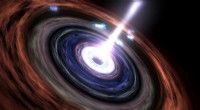
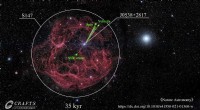
* Mass: While Antares is a red supergiant, it's not massive enough to become a hypernova. Hypernovae are thought to occur in stars with masses at least 20 times that of our Sun. Antares, while large, is estimated to be around 15 times the mass of the Sun.
* Type of Star: Antares is classified as a red supergiant, which typically ends their lives as supernovae, not hypernovae. Hypernovae are more common in rapidly rotating, highly magnetized stars, known as Wolf-Rayet stars.
What will happen to Antares?
* Supernova: Antares is expected to explode as a supernova sometime in the next few thousand years. This event will be incredibly bright and spectacular, potentially outshining the entire Milky Way galaxy for a short period.
* Remnant: After the supernova, Antares will leave behind a dense object, likely a neutron star or a black hole.
It's important to note: Our understanding of stellar evolution is constantly evolving, and there's always a chance for surprises. However, based on current knowledge, Antares is more likely to end its life as a standard supernova rather than a hypernova.