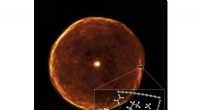
* Red Giant Phase: As the Sun runs out of hydrogen fuel in its core, it will start to fuse hydrogen in a shell surrounding the core. This will cause the Sun to expand dramatically, becoming a red giant star. Its outer layers will engulf Mercury, Venus, and possibly Earth.
* Helium Fusion: Eventually, the Sun's core will be mostly helium. At this point, the core will contract and heat up, eventually becoming hot enough to fuse helium into carbon and oxygen. This fusion process will be much more intense than hydrogen fusion, causing the Sun to expand even further.
* Planetary Nebula: After a period of instability, the Sun's outer layers will be ejected into space, creating a beautiful, glowing shell of gas known as a planetary nebula. This nebula will eventually dissipate, leaving behind a very dense, hot core.
* White Dwarf: The remaining core of the Sun, composed mainly of carbon and oxygen, will be a white dwarf star. This is a very small, dense star that slowly cools down over billions of years, eventually becoming a black dwarf.
Note: Black dwarfs are theoretical objects that have not yet been observed because they take trillions of years to form.
The fate of Earth:
* It's highly likely that Earth will be engulfed by the Sun during its red giant phase. Even if it survives that, the intense radiation and solar wind from the Sun will make the planet uninhabitable long before the Sun becomes a white dwarf.
In short, the Sun's future is one of dramatic change and eventual demise. Though this process will take billions of years, it's a reminder of the finite nature of stars and the vast timescale of cosmic evolution.