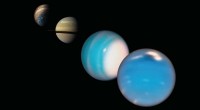
* Composition: Jovian planets are primarily composed of lighter elements like hydrogen and helium, which are much less dense than the heavier elements like iron, nickel, and silicon that make up the terrestrial planets.
* Gas Giants: Jupiter and Saturn are gas giants, meaning they are mostly composed of gas. Even though they have solid cores, the vast majority of their mass is in the form of gas, making them less dense overall.
* Ice Giants: Uranus and Neptune are classified as ice giants. They have a higher proportion of heavier elements like oxygen, carbon, and nitrogen, which are still less dense than the metals found in terrestrial planets.
* Internal Structure: The immense pressure and temperature inside Jovian planets compress the gas and "ice" to some extent, but not enough to make them as dense as terrestrial planets.
Example:
* Jupiter, the largest planet in our solar system, has a density of only 1.33 g/cm³, which is less than water (1 g/cm³).
In conclusion, Jovian planets have low density due to their composition of lighter elements and gaseous or icy nature.