1. Receding Objects:
* The most famous implication of redshift is its connection to expansion of the universe. Light from distant galaxies is shifted towards the red end of the electromagnetic spectrum, indicating that these galaxies are moving away from us. This phenomenon is known as cosmological redshift.
* The further away a galaxy is, the greater its redshift, implying a faster recession speed. This relationship forms the basis of Hubble's Law, which connects redshift with distance.
2. Velocity and Motion:
* Redshift can also be used to determine the velocity of objects within our own galaxy, like stars and gas clouds. This is known as Doppler redshift.
* It helps astronomers understand the dynamics of galaxies, including the rotation of spiral galaxies and the motion of stars within clusters.
3. Properties of Objects:
* Analyzing the amount and pattern of redshift can provide information about the composition and temperature of celestial objects. For example, studying the redshift of emission lines from distant galaxies can reveal the presence of specific elements.
4. Early Universe and Evolution:
* Redshift is a powerful tool for studying the early universe. Observing very distant objects with large redshifts allows astronomers to glimpse the universe as it was billions of years ago, providing clues about its initial conditions and evolution.
5. Gravitational Lensing:
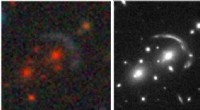
* Redshift can also be affected by the gravitational pull of massive objects, a phenomenon known as gravitational lensing. This effect bends light paths and can cause redshifting or blueshifting, providing information about the distribution of matter and the strength of gravitational fields.
In summary, redshift is a key tool for astronomers to:
* Understand the expansion of the universe
* Measure the velocity of celestial objects
* Analyze the composition and temperature of objects
* Study the early universe and its evolution
* Investigate the effects of gravitational lensing
Redshift, alongside other observational techniques, continues to play a vital role in advancing our understanding of the cosmos.