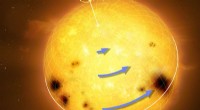
1. Gravity:
* The star's gravity pulls on the planet. This force acts like an invisible tether, constantly drawing the planet towards the star.
* The planet's inertia resists this pull. Inertia is the tendency of an object to stay in motion at a constant speed and direction. So, the planet wants to move in a straight line.
2. Balance of Forces:
* The combination of gravity and inertia creates a balance. The planet is constantly falling towards the star due to gravity, but its inertia keeps it moving forward, preventing it from crashing into the star. This results in a curved path, which we call an orbit.
* The speed of the planet is just right. If the planet were moving too slowly, it would fall into the star. If it were moving too fast, it would escape the star's gravity and fly off into space.
Think of it like a ball on a string:
* The ball (planet) is pulled towards your hand (star) by the string (gravity).
* The ball's inertia wants to keep it moving in a straight line.
* The tension in the string (gravity) forces the ball to move in a circle.
In summary: Planets orbit stars because of the constant pull of gravity from the star, which is balanced by the planet's own inertia. This balance creates a curved path, resulting in an orbit.