1. General Relativity and its Implications for Astronomy:
* Gravitational Lensing: Einstein's theory of general relativity predicted that massive objects like stars or galaxies could bend light, causing it to travel along curved paths. This phenomenon, known as gravitational lensing, was later confirmed through observations and has become a powerful tool in astronomy for studying distant galaxies and dark matter.
* Cosmological Constant: Einstein initially introduced the cosmological constant to counteract the gravitational collapse predicted by his equations. While he later retracted it, the cosmological constant has been revived to explain the accelerated expansion of the universe, a discovery that has revolutionized our understanding of cosmology.
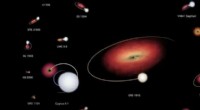
* Black Holes: While the concept of black holes existed before Einstein, his general relativity provided the theoretical framework for understanding these extreme objects. His equations predicted that when a massive star collapses under its own gravity, it can form a singularity where gravity becomes infinitely strong, creating a black hole.
2. Other Astronomical Contributions:
* Redshift: Einstein's general relativity predicted that light from distant galaxies would be redshifted due to the expansion of the universe. This prediction was later confirmed by Edwin Hubble, leading to the development of the Big Bang theory.
* Time Dilation: Einstein's theory of relativity also predicted that time runs slower in strong gravitational fields. This effect is important for understanding the behavior of objects near massive objects like black holes and has implications for the accuracy of astronomical measurements.
3. Inspiration and Influence:
* Scientific Revolution: Einstein's work fundamentally changed our understanding of space, time, and gravity, paving the way for modern cosmology and astrophysics.
* Technological Advancements: His theories have been essential in the development of technologies like GPS satellites, which rely on precise measurements of time dilation.
In summary, while Einstein's primary focus was on theoretical physics, his work had profound implications for astronomy. He provided the theoretical framework for understanding the universe on a vast scale, leading to groundbreaking discoveries and a revolution in our understanding of the cosmos.