Here's a breakdown:
Types of Fluxes:
* Radiant Flux: This measures the energy flow from a source, usually in units of Watts per square meter (W/m²).
* Particle Flux: This measures the number of particles passing through a certain area per unit time. For example, it could be the number of photons per second per square meter (photons/s/m²).
Important Concepts:
* Luminosity: This is the total energy radiated by an object per unit time. Flux is related to luminosity, but it's specific to the amount of energy received at a particular distance.
* Inverse Square Law: The flux decreases with the square of the distance from the source. This means that if you double the distance, the flux drops by a factor of four.
* Spectral Flux: This measures the flux at a specific wavelength or frequency range. It's often plotted as a spectral energy distribution (SED), which shows how the flux varies with wavelength.
Applications:
Fluxes are crucial in astronomical research for:
* Understanding the properties of stars and other objects: By analyzing their fluxes, we can learn about their temperature, luminosity, size, and composition.
* Studying cosmic evolution: The fluxes from distant objects help us understand the evolution of the universe, the formation of galaxies, and the birth of stars.
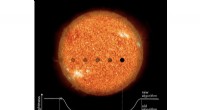
* Detecting and characterizing exoplanets: Analyzing the flux variations caused by exoplanets transiting their host stars allows us to study their size, atmosphere, and orbital properties.
Examples:
* The solar flux at Earth's distance from the Sun is about 1360 W/m².
* The flux of cosmic rays at Earth's surface is about 100 particles per square meter per second.
* Astronomers study the spectral flux of distant galaxies to understand their composition and star formation history.
Fluxes are essential tools in astronomical research, allowing us to study and understand the Universe's properties and processes in great detail.