Here's a breakdown:
* Orbit: This is the curved path a celestial object takes around another, due to the force of gravity.
* Revolution: This refers to the complete movement of one celestial body around another.
* Gravity: The force of attraction between any two objects with mass. The more massive an object, the stronger its gravitational pull.
Types of Orbits:
Orbits can be various shapes, with the most common being:
* Circular orbits: These are perfect circles, with the orbiting object maintaining a constant distance from the center.
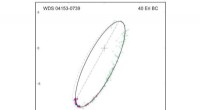
* Elliptical orbits: These are oval-shaped, with the orbiting object varying in distance from the center.
* Parabolic and hyperbolic orbits: These are open paths where the orbiting object escapes the gravitational influence of the central body.
Factors Affecting Orbits:
* Mass of the central body: The more massive the central body, the stronger its gravitational pull, influencing the shape and speed of the orbit.
* Speed of the orbiting body: The speed of the orbiting object determines the shape of its orbit.
* Other celestial objects: Gravitational forces from other objects in the system can influence the orbit.
Examples:
* Earth orbits the Sun in an elliptical path.
* The Moon orbits the Earth in an elliptical path.
* Satellites orbit the Earth in various shapes, from circular to elliptical.
Understanding orbits is fundamental to astronomy and space exploration, helping us to predict the movements of celestial objects and plan missions.