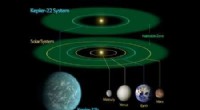
1. Gravity: The sun's immense gravity pulls on the planets, constantly trying to draw them closer.
2. Inertia: Planets are in motion, and due to inertia, they tend to move in a straight line.
How it works:
* Initial conditions: When a planet is formed, it has a certain initial velocity and position relative to the sun.
* Gravitational pull: The sun's gravity pulls on the planet, trying to pull it into a straight line towards the sun.
* Inertia: The planet's inertia keeps it moving in a straight line tangent to its orbit.
* Compromise: The combination of gravity and inertia results in a compromise: the planet's path becomes a curved orbit.
* Elliptical shape: The shape of the orbit is elliptical because the speed of the planet is not constant throughout the orbit. It moves faster when it is closer to the sun and slower when it is farther away. This variation in speed creates the elliptical shape.
In simpler terms:
Imagine a ball tied to a string being swung around. The string represents gravity, pulling the ball towards the center. The ball's inertia wants it to fly off in a straight line. The result is a circular or elliptical path. The same principle applies to planets around the sun.
Important note: While we describe orbits as elliptical, they are not perfectly elliptical due to the gravitational influence of other planets and various other factors.