Flybys:
* Pioneer 10 (1973): The first spacecraft to fly past Jupiter, sending back the first close-up images.
* Pioneer 11 (1974): Took the first close-up images of Jupiter's poles and its Great Red Spot.
* Voyager 1 (1979): Captured stunning images of Jupiter's atmosphere, its moons, and its rings.
* Voyager 2 (1979): Provided further insights into Jupiter's atmosphere, moons, and magnetic field.
* Ulysses (1992, 2000): Studied Jupiter's magnetosphere and its interaction with the solar wind.
* New Horizons (2007): Flew past Jupiter on its way to Pluto, taking valuable observations of the giant planet.
Orbiters:
* Galileo (1995-2003): The first spacecraft to orbit Jupiter, sending back detailed information about its atmosphere, moons, and magnetic field. It also deployed a probe that plunged into Jupiter's atmosphere.
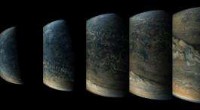
* Juno (2016-present): Currently orbiting Jupiter, studying its gravitational field, magnetic field, and atmospheric composition.
No spacecraft has landed on Jupiter.
Why no landing?
* Extreme pressure: Jupiter's atmosphere is incredibly dense, with crushing pressure increasing rapidly as you descend. No spacecraft could withstand the pressure.
* Lack of solid surface: Jupiter is a gas giant, meaning it has no solid surface to land on.
Future Missions:
* Europa Clipper (launch planned for 2024): This mission will orbit Jupiter and focus on studying its moon Europa, which is thought to harbor a potentially habitable ocean beneath its icy surface.