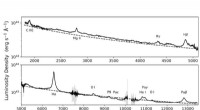
* Reflected starlight: The nebula itself doesn't emit light, but rather scatters light from a nearby star. This means the spectrum of the nebula will closely resemble the spectrum of the illuminating star.
* Blue color: Because blue light scatters more effectively than red light, reflection nebulae often appear bluish. This is similar to why the sky appears blue during the day - the sunlight is scattered by the Earth's atmosphere, with blue light being scattered more strongly.
* Absorption lines: While the overall spectrum is similar to the star's, there might be some slight absorption lines present. These are caused by the interstellar dust and gas within the nebula itself absorbing certain wavelengths of light.
* Emission lines: In some cases, the nebula might also exhibit weak emission lines, particularly if the illuminating star is hot enough to ionize some of the gas within the nebula. This would then cause the gas to emit light at specific wavelengths.
In summary:
* Dominant feature: Reflected starlight, similar to the spectrum of the illuminating star.
* Color: Often bluish due to scattering of blue light.
* Other features: Potential absorption lines from dust and gas, and possibly weak emission lines if the star is hot enough.
It's important to note that the exact spectrum of a reflection nebula can vary depending on the properties of the illuminating star and the composition of the nebula itself.