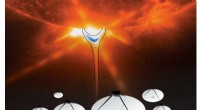
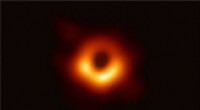
1. Accretion Disk: Gas and dust from the surrounding galaxy are pulled towards the SMBH by its intense gravity. This material forms a swirling disk around the black hole, called an accretion disk. Friction and collisions within the disk heat the material to incredibly high temperatures, emitting vast amounts of radiation, primarily in the form of X-rays.
2. Jets: Some of the infalling material is ejected outward from the poles of the SMBH at speeds approaching the speed of light. These jets are extremely powerful and can carry a substantial portion of the quasar's energy. The exact mechanism for jet formation is still debated, but likely involves magnetic fields interacting with the accretion disk.
3. Gravitational Energy Conversion: As matter spirals closer to the SMBH, its gravitational potential energy is converted into kinetic energy. This kinetic energy is then transformed into heat and radiation as the matter collides and interacts within the accretion disk.
4. Relativistic Effects: The extreme gravity of the SMBH distorts spacetime around it. This results in relativistic effects like gravitational lensing, where light from the quasar is bent and magnified, contributing to its observable brightness.
In essence, the energy powering a quasar comes from the conversion of gravitational potential energy into other forms of energy (heat, radiation, kinetic energy of jets) as matter is consumed by the supermassive black hole.