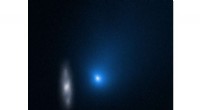
* Brightness vs. Luminosity: The brightness we see from a star is its *apparent magnitude*, which is how bright it *appears* from Earth. This depends on both how much light it actually emits (its *luminosity*) and how far away it is.
* Distance is Key: The dimmer star could actually be *more* luminous than the bright one, but it's simply much farther away. Imagine two light bulbs. One is a 100-watt bulb close to you, and the other is a 1000-watt bulb far away. The 1000-watt bulb is actually brighter, but the closer 100-watt bulb appears brighter because of its proximity.
* Other Factors: The color of a star also plays a role. A blue star, for example, emits more energy than a red star of the same size, even if they appear similarly bright to the naked eye.
So, how can we be sure which star is actually brighter? We need to consider the distance to each star, which is often calculated by astronomers using various methods like parallax.