1. Luminosity: A more massive star is significantly more luminous. The luminosity of a star increases roughly as the fourth power of its mass (L ∝ M⁴). This means that a star twice as massive as the Sun will be 16 times brighter.
2. Surface Temperature: Massive stars are hotter than less massive stars. The core temperature and pressure increase with mass, leading to faster nuclear fusion rates and higher surface temperatures.
3. Lifetime: Massive stars burn through their fuel much faster than less massive stars. Their high core temperatures and pressures accelerate nuclear fusion, leading to shorter lifespans. A star 10 times more massive than the Sun will have a lifetime approximately 100 times shorter.
4. Spectral Type: Massive stars tend to be bluer in color due to their high surface temperatures. They are classified as O, B, or A stars on the spectral classification system.
5. Evolution: Massive stars undergo more complex evolutionary stages. They may experience multiple stages of fusion, including the fusion of heavier elements like carbon, oxygen, silicon, and ultimately iron.
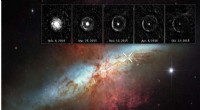
6. End of Life: Massive stars end their lives in spectacular supernova explosions. Their cores collapse under gravity, producing a neutron star or black hole.
7. Influence on Surrounding Environment: The intense radiation and stellar winds from massive stars can significantly influence the surrounding interstellar medium, triggering star formation in nearby regions.
Examples:
* Sun: A relatively small, yellow star with a moderate lifespan.
* Sirius: A massive, white star much hotter and brighter than the Sun, with a much shorter lifespan.
* Rigel: A blue supergiant star, significantly more massive and luminous than the Sun, with a very short lifespan.
In summary, an increase in mass significantly impacts a star's fundamental properties, leading to higher luminosity, surface temperature, faster evolution, and a more dramatic end of life.