General Appearance:
* Giant and Gaseous: Jupiter is the largest planet in our solar system, a massive ball of gas with no solid surface.
* Striped and Swirling: Its most striking feature is the colorful, swirling bands of clouds that stretch across its surface. These bands are caused by differences in the planet's atmospheric composition and winds.
* Great Red Spot: A giant, swirling storm known as the Great Red Spot is a prominent feature, visible even from Earth-based telescopes. It's larger than Earth itself and has been raging for centuries.
Colors and Details:
* Dominant Colors: Jupiter's clouds are mainly shades of white, orange, brown, and red.
* Fine Details: Images captured by spacecraft reveal intricate cloud patterns, atmospheric disturbances, and even lightning storms.
* Polar Regions: The planet's poles are shrouded in blue and white clouds, distinct from the equatorial bands.
The View from Different Spacecraft:
* Voyager Missions: Early images from Voyager 1 and 2 gave us our first close-up look at Jupiter's grandeur, revealing its swirling bands, Great Red Spot, and moons.
* Juno Mission: Juno, orbiting Jupiter since 2016, has captured stunning high-resolution images, providing unprecedented views of its atmospheric structure, magnetic field, and even glimpses into its internal workings.
Beyond the Visuals:
* Powerful Magnetic Field: Jupiter has an incredibly strong magnetic field, hundreds of times stronger than Earth's.
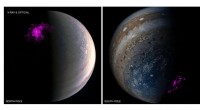
* Intense Auroras: The planet experiences spectacular auroras, much more powerful than those seen on Earth.
A Cosmic Wonder:
Jupiter's beauty and complexity are a testament to the wonder of our solar system. Viewing it from space reveals a truly awe-inspiring and dynamic world.