1. Redshift of Distant Galaxies:
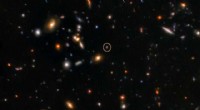
* Observation: Edwin Hubble observed that light from distant galaxies is shifted towards the red end of the spectrum. This is known as redshift.
* Interpretation: Redshift indicates that galaxies are moving away from us, and the farther away they are, the faster they are moving. This is consistent with the idea that the universe is expanding from a single point.
2. Cosmic Microwave Background Radiation (CMB):
* Observation: In the 1960s, Arno Penzias and Robert Wilson accidentally discovered faint microwave radiation coming from all directions in space.
* Interpretation: The CMB is the afterglow of the Big Bang. It's a remnant of the extremely hot, dense state of the early universe that has cooled down over time. The uniformity of the CMB across the sky supports the idea of a homogeneous, expanding universe.
3. Abundance of Light Elements:
* Observation: The universe is primarily composed of hydrogen and helium, with trace amounts of other light elements like lithium and beryllium.
* Interpretation: These abundances can be explained by nuclear fusion reactions that occurred in the very early universe, within the first few minutes after the Big Bang.
4. Structure Formation:
* Observation: Galaxies are not randomly distributed in the universe. They form large-scale structures like clusters and filaments.
* Interpretation: The Big Bang theory predicts that tiny fluctuations in the early universe would grow over time, leading to the formation of these structures. These fluctuations have been observed in the CMB.
5. Age of the Universe:
* Observation: By measuring the rate of expansion and extrapolating backwards, scientists have estimated the age of the universe to be about 13.8 billion years.
* Interpretation: This age is consistent with the ages of the oldest stars and other celestial objects observed in the universe.
6. Evolution of Stars and Galaxies:
* Observation: Astronomers observe the evolution of stars and galaxies over time, from their birth to their death.
* Interpretation: These observations are consistent with the Big Bang model, which predicts how the universe has evolved from a hot, dense state to the cooler, less dense state we see today.
7. General Relativity:
* Theory: Einstein's theory of general relativity provides a framework for understanding the expansion of the universe and its large-scale structure.
* Interpretation: Observations support the predictions of general relativity, which are consistent with the Big Bang theory.
Conclusion:
The Big Bang theory is not just based on a single piece of evidence but on a vast collection of observations across various fields of astronomy and physics. These observations are remarkably consistent with the model, making it the most compelling explanation for the origin and evolution of our universe.