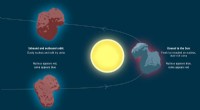
* Gravity: The Sun's immense gravity pulls on the planets, trying to draw them closer.
* Inertia: Planets are constantly moving, and this motion tends to make them fly off in a straight line.
Here's how it works:
1. Initial Momentum: When the solar system formed, the planets were set in motion. They inherited the spinning motion of the cloud of gas and dust from which they formed. This initial momentum gave them a velocity that was just right for their orbit.
2. Balance Act: Imagine a planet moving in a straight line. Gravity pulls it towards the Sun, bending its path into a curve. If the planet were moving too slowly, it would be pulled into the Sun. If it were moving too fast, it would fly off into space.
3. Orbital Path: The perfect balance between gravity and inertia results in a continuous, elliptical orbit. The planet is constantly falling towards the Sun, but its sideways motion keeps it from crashing into the Sun. It effectively falls around the Sun.
Think of it like this:
* Swinging a ball on a string: You need to keep swinging the ball to keep it from falling to the ground. The string acts like gravity, pulling the ball towards your hand.
* Riding a roller coaster: The track keeps the roller coaster from flying off, while gravity keeps it on the track.
In summary, planets stay in orbit because they are constantly moving and the Sun's gravity is just strong enough to keep them from flying off but not strong enough to pull them in.