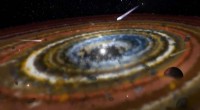
1. Birth: Polaris began as a massive star, likely several times larger than our Sun, from a giant cloud of gas and dust.
2. Main Sequence: For millions of years, Polaris fused hydrogen into helium in its core, like our Sun. This stage is called the main sequence.
3. Red Giant: As the hydrogen fuel ran out, Polaris started fusing helium into heavier elements. This led to an expansion of the star, becoming a red giant.
4. Yellow Supergiant: Currently, Polaris is in a phase where it has expanded further, and its outer layers have cooled slightly, making it a yellow supergiant. It is still fusing heavier elements in its core, and it pulsates, varying in brightness slightly.
5. Future: Polaris is nearing the end of its life. In the next few million years, it will explode as a supernova, leaving behind a neutron star or possibly a black hole.
The "transition" into its current yellow supergiant stage is a gradual process driven by the depletion of hydrogen in the core and the subsequent fusion of heavier elements. It's important to remember that stellar evolution is a continuous process, with no abrupt transitions. Polaris is simply in a specific phase of its evolution, and its future will be determined by its mass and internal processes.