Sun-like stars, those with similar mass to our own Sun, go through a predictable lifecycle that spans billions of years. Here's a breakdown of the major stages:
1. Birth:
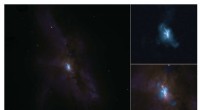
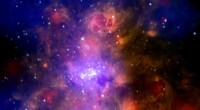
* Nebular Collapse: Stars form from vast, cold, and diffuse clouds of gas and dust called nebulae. Gravity pulls these materials together, causing the cloud to collapse and heat up.
* Protostar: As the cloud collapses, it forms a dense, hot core called a protostar. This core continues to accrete matter and heat up, eventually reaching temperatures and pressures sufficient for nuclear fusion to begin.
* Main Sequence Star: Nuclear fusion ignites in the core, releasing immense energy and stabilizing the star. The star enters the main sequence stage, where it spends the majority of its life, fusing hydrogen into helium. Our Sun is currently in this stage.
2. Red Giant Stage:
* Hydrogen Depletion: As the star ages, its core runs out of hydrogen fuel. The core contracts, while the outer layers expand and cool, turning the star into a red giant.
* Helium Fusion: The core becomes hot and dense enough to ignite helium fusion, producing heavier elements like carbon and oxygen. The star becomes even brighter and larger.
* Instability: The red giant phase is unstable and involves pulsations and mass loss through stellar winds.
3. Planetary Nebula:
* Core Collapse: As the core runs out of fuel, it collapses under its own gravity. This triggers a series of shock waves that push the outer layers of the star into space, creating a beautiful, expanding cloud of gas and dust known as a planetary nebula.
* White Dwarf: The remaining core is a dense, hot object called a white dwarf, composed mainly of carbon and oxygen. It emits no new light and gradually cools over billions of years.
4. Black Dwarf:
* Cooling: Over an incredibly long time, the white dwarf continues to cool and fade, eventually becoming a cold, dark object called a black dwarf. This process takes trillions of years and is hypothetical as the universe isn't old enough for any black dwarfs to have formed yet.
Important Notes:
* The lifespan of a sun-like star is directly related to its mass. More massive stars live faster and die younger.
* While the general process is similar, the details of the evolution can vary slightly depending on the star's mass and composition.
* Stellar evolution is a fascinating and complex process that involves intricate interplay of gravity, nuclear fusion, and energy transfer.
This explanation provides a simplified overview of the evolution of a sun-like star. For a deeper understanding, you can explore more detailed resources on stellar evolution and astrophysics.