1. Proton-Proton Chain Reaction:
* Step 1: Two protons (hydrogen nuclei) collide with enough energy to overcome their electrostatic repulsion. This is possible due to the extreme heat and pressure in the star's core.
* Step 2: One proton decays into a neutron, emitting a positron (antimatter electron) and a neutrino.
* Step 3: The neutron and remaining proton combine to form a deuterium nucleus (one proton and one neutron).
* Step 4: A deuterium nucleus collides with another proton, forming a helium-3 nucleus (two protons and one neutron).
* Step 5: Two helium-3 nuclei collide, forming a helium-4 nucleus (two protons and two neutrons) and releasing two protons.
Simplified Equation:
4¹H → ⁴He + 2e⁺ + 2νe + 2γ
Important Points:
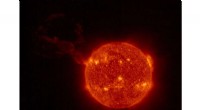
* Energy Release: The process releases a massive amount of energy, primarily in the form of gamma rays (γ). This energy is what powers the star and keeps it shining.
* High Temperatures and Pressures: The core of a star needs to be extremely hot (millions of degrees Celsius) and have immense pressure to overcome the electrostatic repulsion of the protons.
* Quantum Tunneling: This process actually occurs via quantum tunneling, where protons have a slight chance of passing through the barrier of their electrostatic repulsion, even if they don't have enough energy to overcome it classically.
* Further Fusion: The helium produced can undergo further fusion to create heavier elements, driving the evolution of the star.
The proton-proton chain reaction is the primary fusion process in stars like our Sun. Larger, hotter stars use a different process called the carbon-nitrogen-oxygen (CNO) cycle.
Let me know if you'd like a more detailed explanation of any specific step or a discussion of the CNO cycle!