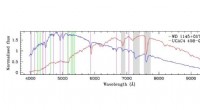
1. Exoplanets: The primary discovery enabled by this method is the detection of exoplanets, planets orbiting stars outside our solar system. When a planet orbits a star, its gravitational pull causes the star to wobble slightly. This wobble can be detected by measuring small shifts in the star's light spectrum, which are caused by the Doppler effect.
2. Characteristics of Exoplanets: By analyzing the wobble patterns, astronomers can determine several characteristics of the exoplanet:
* Mass: The size of the wobble reveals the mass of the planet.
* Orbital period: The time it takes for the planet to complete one orbit around the star.
* Orbital eccentricity: The shape of the planet's orbit, whether it's more circular or elliptical.
3. Stellar Properties: In addition to exoplanet discoveries, the radial velocity method can provide insights into the star itself:
* Stellar mass: The size of the wobble also depends on the mass of the star.
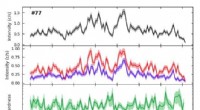
* Stellar activity: The method can reveal changes in the star's activity, like sunspots and flares, which can mimic the wobble caused by an orbiting planet.
4. Binary Star Systems: The method can also be used to study binary star systems, where two stars orbit each other. By analyzing the wobble patterns of both stars, astronomers can determine their masses and orbital properties.
5. Other Discoveries:
* Exomoons: While not as common as exoplanet discoveries, the radial velocity method has also been used to detect the presence of moons orbiting exoplanets.
* Stellar Evolution: By studying the wobbles of multiple stars at different stages of their lives, astronomers gain valuable insights into stellar evolution and the formation of planetary systems.
The radial velocity method has revolutionized our understanding of planetary systems beyond our own. It has been responsible for the discovery of thousands of exoplanets and continues to be a powerful tool for exploring the universe.